
USE CASES
Three ways an Anchor gets deployed. Pick the one that looks like your network.
The sizing rule never changes — Cores where paths terminate, Edges everywhere they originate — but where the Anchor actually sits depends on whether you own the network in the middle or only the edge. These are the three deployment topologies we build against, not hypothetical diagrams.
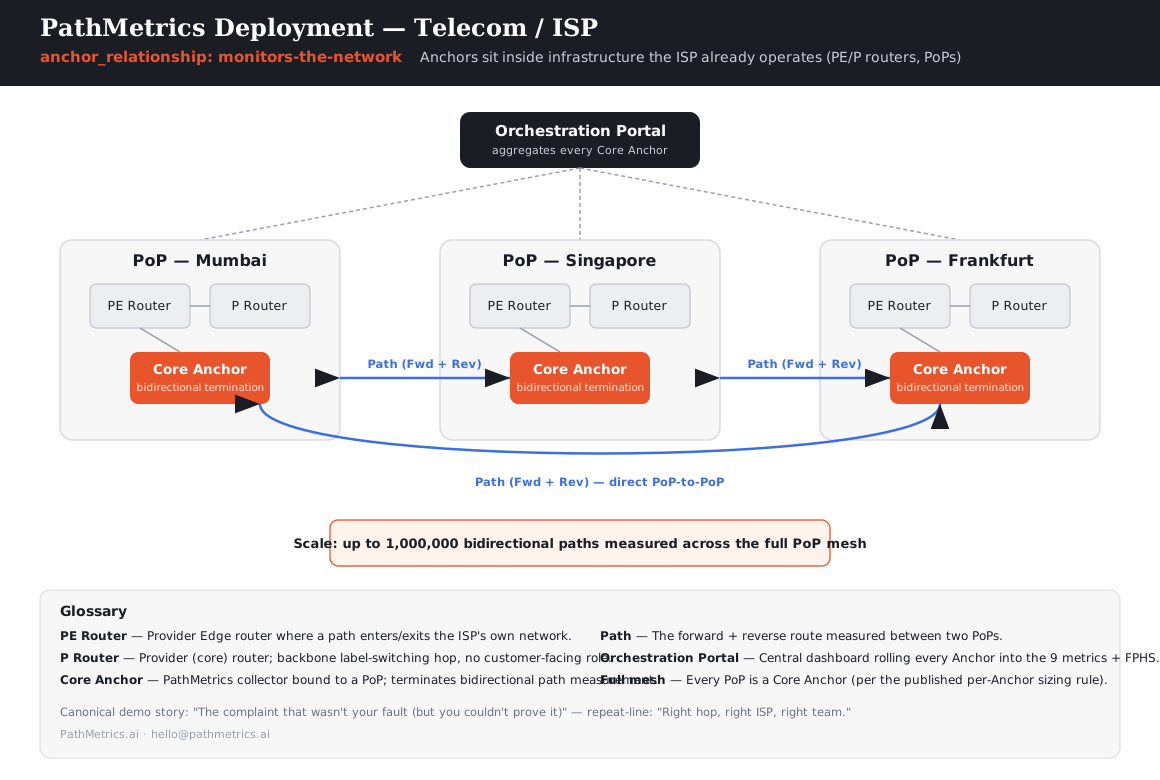
anchor_relationship: monitors-the-network
Telecom / ISP — full mesh, PoP to PoP
Anchors sit inside infrastructure the ISP already operates — PE and P routers at each Point of Presence. Every PoP is a Core Anchor, terminating bidirectional measurement to every other PoP in the mesh. There's no edge/core split here: at carrier scale, every node is a hub.
TOPOLOGY
Full mesh
Every PoP is a Core Anchor. Sizing rule: Cores = PoPs, no Edges — every node terminates bidirectional measurement to every other node.
SCALE
Up to 1,000,000 paths
Bidirectional paths measured across a full PoP mesh at carrier scale — this is the deployment shape that stress-tests the platform hardest.
DEMO STORY
“Right hop, right ISP, right team.”
The complaint that wasn’t your fault, but you couldn’t prove it — until the reverse-path hop lands on the peer’s side of the interconnect.
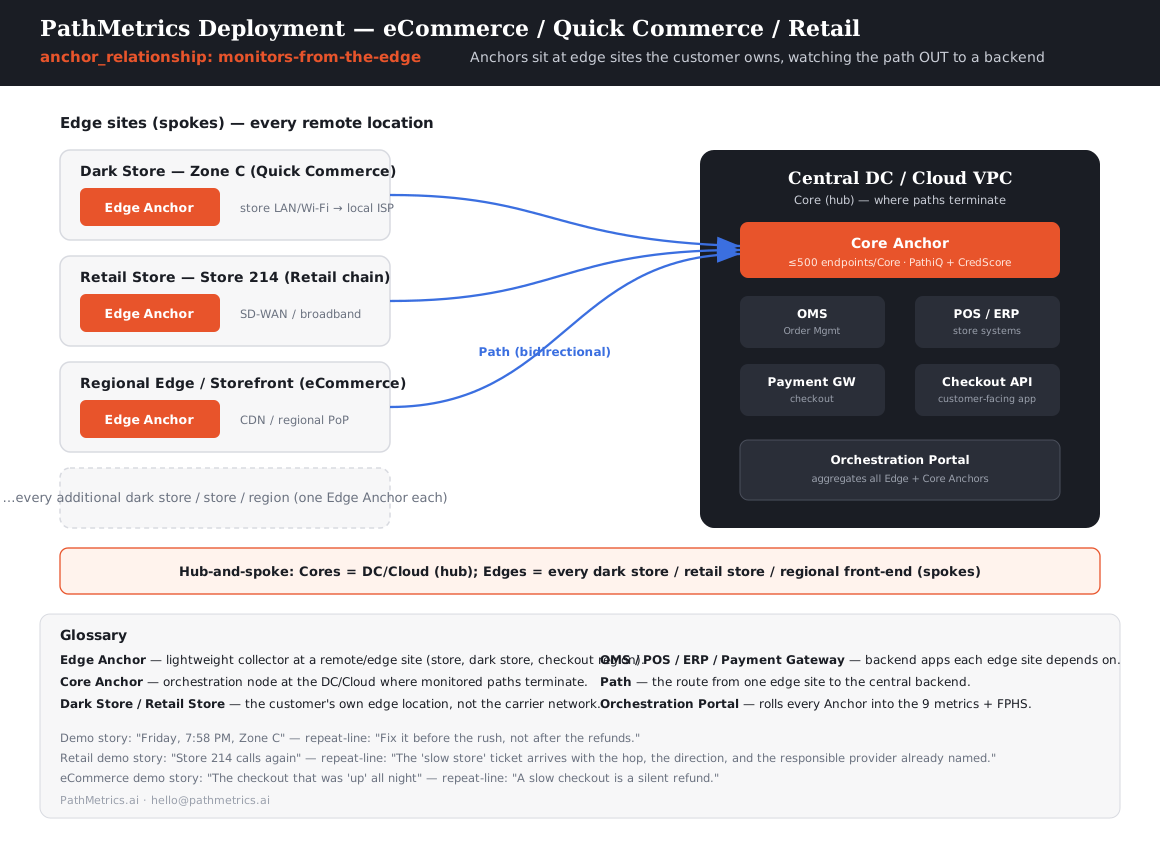
anchor_relationship: monitors-from-the-edge
eCommerce · Quick Commerce · Retail — hub-and-spoke
Anchors sit at edge sites the customer owns — dark stores, retail locations, regional storefronts — each watching its own path out to a shared backend. The Core Anchor sits once, at the central DC or Cloud VPC, in front of the systems every edge site actually depends on: OMS, POS/ERP, payment gateway, checkout API.
TOPOLOGY
Hub-and-spoke
One Core (DC/Cloud) is the hub. Every dark store, retail store, or regional front-end is one Edge Anchor — a spoke reporting toward it.
WHAT'S WATCHED
Edge → backend, bidirectionally
OMS, POS/ERP, payment gateway, checkout API — the exact systems each edge site can’t function without, measured from the edge’s own vantage point.
DEMO STORIES
Three verticals, one topology
“Friday, 7:58 PM, Zone C” · “Store 214 calls again” · “The checkout that was ‘up’ all night” — same deployment shape, three different repeat-lines.
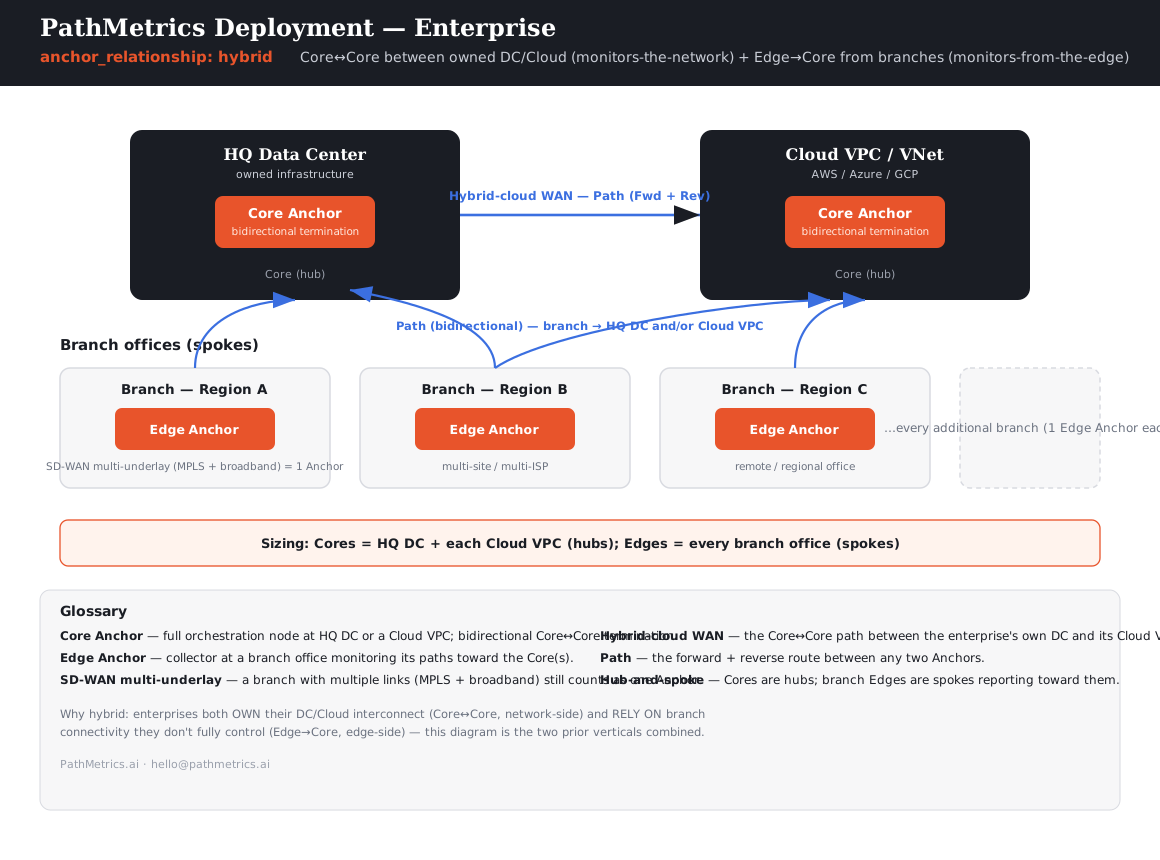
anchor_relationship: hybrid
Enterprise — Core↔Core plus Edge→Core, combined
Enterprises both own their DC/Cloud interconnect and rely on branch connectivity they don't fully control. This deployment is the previous two combined: a Core↔Core hybrid-cloud WAN path between the HQ data center and its Cloud VPC(s), plus Edge Anchors at every branch office reporting toward those Cores.
TOPOLOGY
Hybrid
Core↔Core between owned DC and Cloud VPC (network-side) + Edge→Core from every branch (edge-side) — both relationships in one deployment.
SIZING
Cores = DC + each VPC. Edges = every branch.
A branch running SD-WAN with multiple underlays — MPLS plus broadband — still counts as one Anchor. Interfaces are free; the site is the unit.
WHY IT MATTERS
One tool, both blind spots
Most enterprises monitor the DC they own and hope the branch links behave. PathMetrics watches both relationships with the same nine metrics and the same formula.
See your own topology mapped this way.
The Pilot Pack deploys against your real deployment shape — not a generic diagram.